


For years, we have been given the same health advice. Eat well. Exercise regularly. Get enough sleep. Take your vitamins. Manage your stress.
None of this is bad advice. But there is one major problem
We are not all the same.
Two people can eat the same diet, take the same supplements, follow the same training programme and get the same amount of sleep, yet experience completely different results.
Why?
Because our bodies are different.
Our DNA, metabolism, hormones, body composition, nutritional status, lifestyle and environment can all influence how we respond to the choices we make every day.
This is why healthcare is beginning to move away from a one-size-fits-all approach and towards something far more personalised.
At Harley Longevity Club, we believe that if you want to optimise your health and longevity, you first need to understand your own biology.
Stop guessing. Start testing.
Feeling Healthy Does Not Always Give You the Full Picture
Most of us start investigating our health when something feels wrong.
We develop symptoms, visit a doctor and begin looking for an explanation.
But what if we started asking questions before that point?
You can feel perfectly well while certain markers within the body are beginning to change. Your blood sugar regulation, body composition, liver health, nutritional status or oxidative stress levels, for example, may be telling a story that you cannot necessarily see or feel.
This is where diagnostics become so valuable.
Instead of simply asking, “How do I feel?”, we can also start asking, “What is actually happening inside my body?”
That shift in thinking is at the heart of preventative and personalised healthcare.
Your Health Should Not Be Based on Someone Else’s Body
We are surrounded by health advice.
One month everyone is fasting. The next everyone is taking a particular supplement. Then it is cold plunges, continuous glucose monitors, red light therapy or the latest training protocol.
There is more information available to us than ever before, which can be incredibly useful.
But there is an obvious problem.
The person recommending something online does not have your body.
A supplement that benefits one person may be completely unnecessary for another. A nutritional strategy that works brilliantly for your friend might not be the right approach for you. The exercise programme that transformed somebody else’s body may not address what your own body actually needs.
General health advice still has its place. But the more we understand about the individual, the more informed and personalised those decisions can become.
Your Longevity Journey Should Start With You
At Harley Longevity Club, this is why we believe the first step in your longevity journey should be understanding your own biology.
Your journey begins with the Harley Longevity Club App, powered by UmmuHub for women and Engne for men.
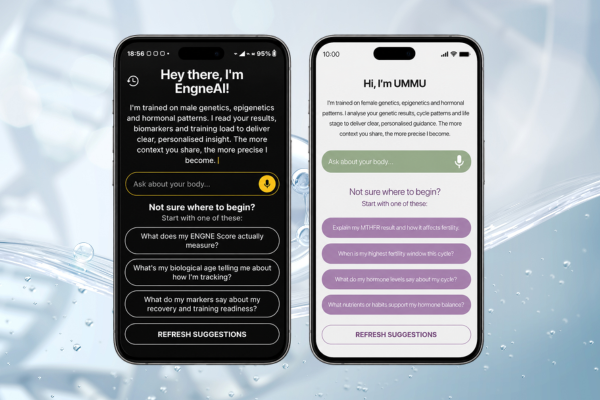
Through a simple at-home saliva test, we can begin to uncover information from your DNA and epigenetics, giving you a much deeper understanding of your individual biological blueprint.
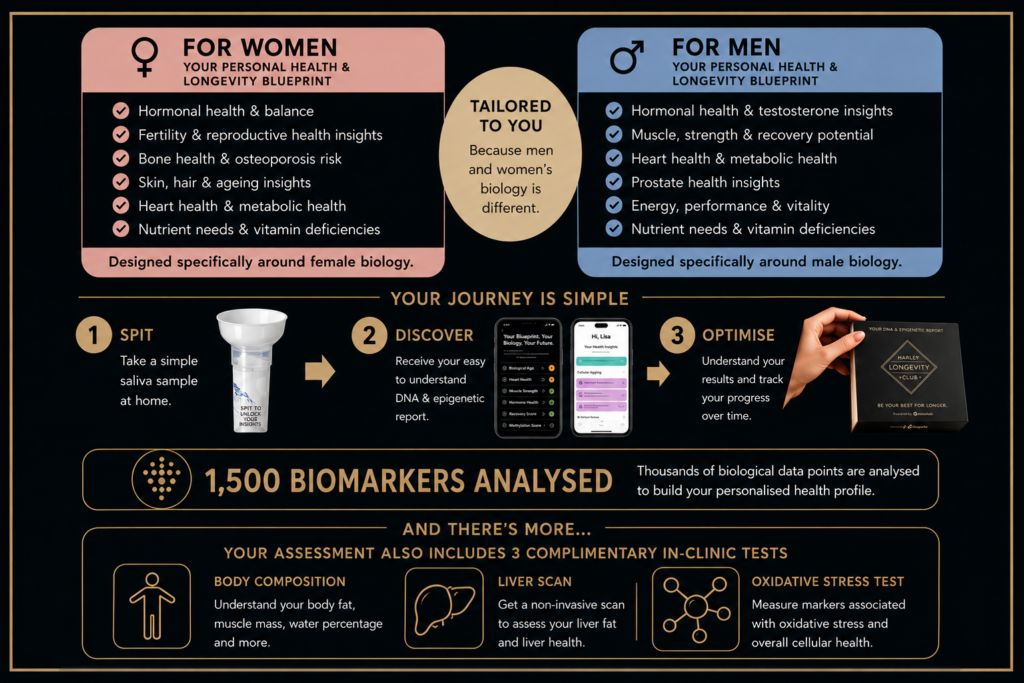
Your DNA is essentially the biological instruction manual you were born with. It can help us understand genetic differences that may influence areas of your health and how your body functions.
Epigenetics gives us another layer of information. It looks at patterns associated with how our genes are being regulated and how these patterns can change with factors such as age, lifestyle and environment.
Together, these insights allow us to start building a far more personalised picture of you.
Rather than beginning with what everybody else is doing, we begin with your own data.
From Your DNA to Your Diagnostics

Your DNA and epigenetic information provide an important foundation, but they are only part of the picture.
The next step is understanding what is happening inside your body right now.
This is where diagnostics and clinical assessments become important.
Depending on the individual, we can begin looking at areas such as:
- Blood biomarkers
- Blood glucose regulation
- Cardiovascular health markers
- Vitamin and mineral status
- Hormonal markers
- Liver health
- Body composition
- Visceral fat
- Muscle mass
- Oxidative stress
By bringing these different layers of information together, we can start to build a much clearer picture of your current health.
Your DNA may help us understand certain predispositions or biological differences.
Your epigenetic information can provide another perspective on ageing and gene regulation.
Your diagnostics tell us more about what is happening within your body today.
And your lifestyle tells us what you are actually doing every day.
That is where personalisation really begins.
Test, Understand, Personalise
Collecting health data simply for the sake of having more numbers is not the goal.
Data becomes valuable when we can understand it and use it to help make better decisions.
That is why our approach at Harley Longevity Club follows a simple philosophy:
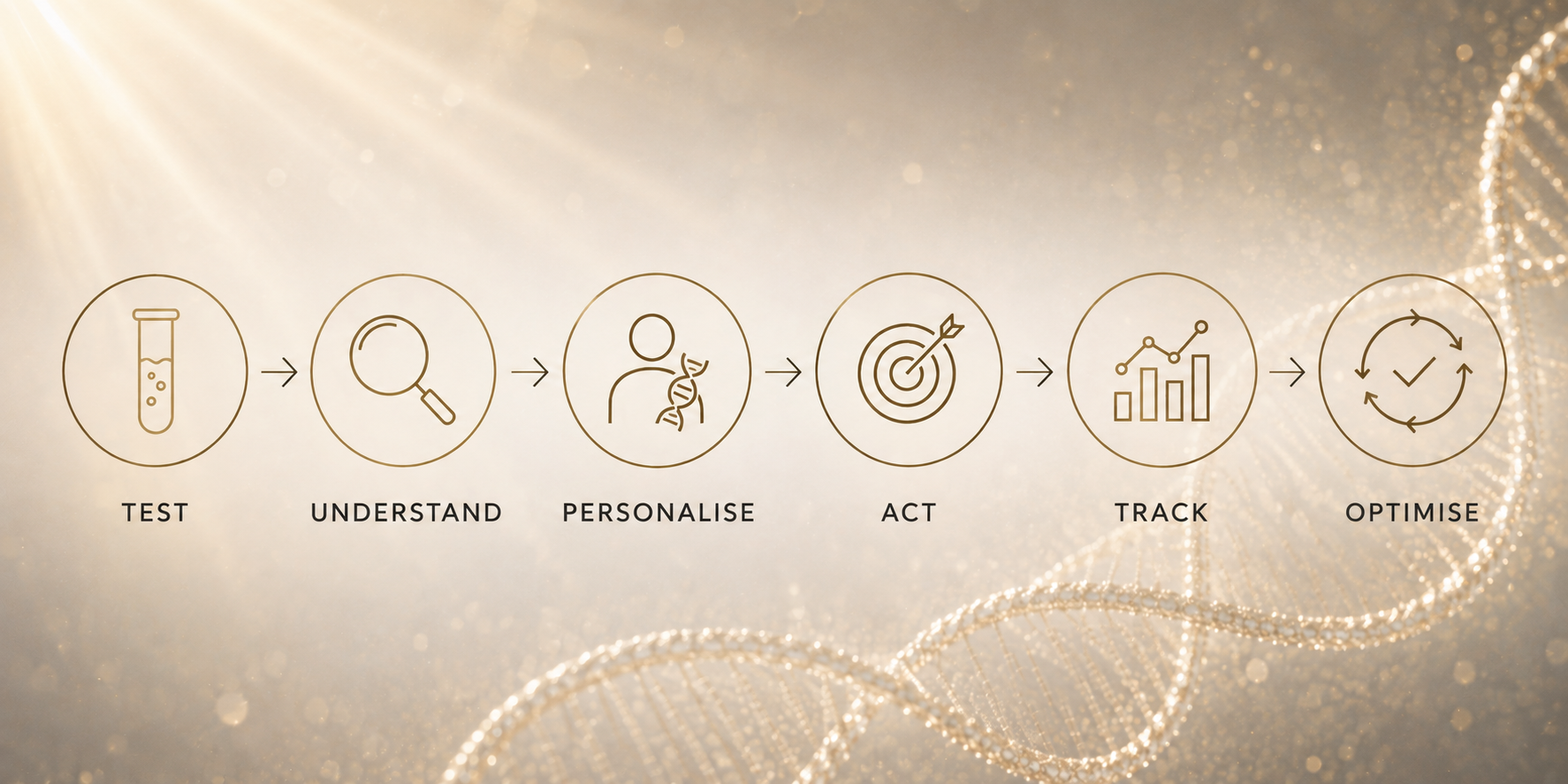
First, we gather information.
Then we help you understand what that information means.
From there, we can begin building a strategy around you rather than simply following generic recommendations.
Taking the Guesswork Out of Nutrition
Nutrition is one of the clearest examples of why personalisation matters.
We often talk about foods as simply being “healthy” or “unhealthy”, but human biology is considerably more complicated than that.
Different people can respond differently to the same foods and dietary approaches.
Your metabolism, activity levels, body composition, genetics and current health markers can all influence what may be appropriate for you.
Diagnostics can provide greater insight into areas such as blood sugar regulation, nutritional status and metabolic health.
Instead of endlessly removing foods, changing diets or copying what someone else eats, you can begin making decisions with more information about your own body.
Exercise Should Be Personal Too
Exercise is one of the most powerful tools we have for supporting long-term health, but even here, more is not always better.
Someone may be doing large amounts of cardiovascular exercise while gradually losing valuable muscle mass.
Another person may benefit from increasing strength training.
Someone else may already be training intensely but needs to place greater emphasis on recovery.
This is why looking beyond your weight on the bathroom scales can be so useful.
Body composition testing can provide information about muscle mass, body fat and visceral fat, allowing exercise goals to become much more specific.
Instead of simply telling everyone to “exercise more”, we can start asking a better question:
What does your body actually need?
Stop Guessing With Supplements

The supplement industry has exploded.
Open social media and you’ll find endless recommendations for vitamins, minerals, powders and longevity supplements.
But taking more does not automatically mean achieving better health.
Without understanding your own body, it can become very easy to build an enormous supplement routine based largely on recommendations designed for somebody else.
Testing can help provide context around where supplementation may be appropriate and, just as importantly, where it may not be necessary.
The aim is to make supplementation part of a considered health strategy rather than simply collecting the latest products recommended online.
Recovery Is Part of Longevity Too
Optimisation is not simply about doing more.
Training harder, fasting longer, eating perfectly and adding another biohack can become counterproductive if the body is not being given the opportunity to recover.
Sleep, stress management, recovery and lifestyle all form part of the bigger picture.
This is another reason why one individual measurement rarely tells us everything we need to know.
The real value comes from looking at different pieces of information together and understanding how they relate to the individual.
From Reactive Healthcare to Preventative Healthcare
For generations, much of healthcare has understandably focused on treating problems once symptoms or disease have appeared.
Longevity medicine introduces another important question:
What can we understand about our health today that may help us make better decisions for tomorrow?
This is not about trying to predict every illness or suggesting that every health condition can be prevented.
It is about becoming better informed.
Diagnostics can help establish a baseline, highlight areas that may deserve further attention and allow us to monitor how certain markers change over time.
One test gives you a snapshot.
Repeated testing begins to show you a trend.
And trends can help us understand whether the changes we are making are actually moving us in the direction we want to go.
The Future of Health Is Personal

We now have access to health information that previous generations could never have imagined.
DNA testing, epigenetics, advanced diagnostics, clinical assessments and wearable technology are giving us the opportunity to understand our bodies in increasingly sophisticated ways.
But the goal should never be to become obsessed with numbers.
The goal is to use those numbers intelligently.
At Harley Longevity Club, your longevity journey starts with the Harley Longevity Club App, powered by UmmuHub for women and Engne for men.
From there, we can begin combining your genetic and epigenetic insights with advanced diagnostics and clinical assessments to build a clearer picture of your health and create a more personalised approach to your longevity journey.
Because your health strategy should not simply be based on what is trending, what works for your friend or what somebody on social media tells you they are doing.
It should begin with understanding you.
Stop guessing. Start testing.
Test. Understand. Personalise. Act. Track. Optimise.
